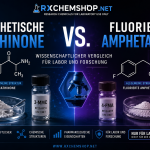
Introduction
European research market 3-MMC (3-methylmethcathinone) and NEP (N-ethylpentedron) to the most famous research chemicals in recent years. Both substances are examined in laboratories and scientific projects and are considered functional alternatives for many researchers. But what similarities and differences are there? And what is the current legal situation in countries like Germany, Austria and the Netherlands?
This article provides a comprehensive overview – especially for researchers, laboratories and interested parties in Europe.
1. Chemical background
1.1 3-MMC (3-methylmethcathinone)
- Structure: belongs to the group of Cathinone
- related to 4-MMC (Mephedron)
- First popularity in Europe: from approx. 2012
- Interesting in laboratory environments due to its stimulating and deactogenic properties
1.2 NEP (N-ethylpentedron)
- Structure: a synthetic cathinon with ethylated side chain
- Rivets chemically to the known N-ethylcathinone
- First relevance in Europe: around 2015
- In research contexts known for stronger stimulants profiles compared to 3-MMC
Two. Similarities between 3-MMC and NEP
- Both belong to the group of Cathinone → similar basic structure.
- Stimulant Character: Both exhibit effects associated with increased activity and drive in laboratory tests.
- Research interest: The mechanisms are compared, especially in neurochemistry and pharmacology.
- Market in Europe: Both substances have long been among the most popular research chemicals in Germany, Austria and the Netherlands.
3. Differences between 3-MMC and NEP
| Characteristic | 3-MMC | NEP |
| Chemical structure | methylated Cathinon compound | Ethylated Cathinon compound |
| Dissemination | approx. 2012 in Europe | approx. 2015 in Europe |
| Research focus | Deacted properties | Stimulants properties |
| Known for | Near to 4-MMC (Mephedron) | Close to α-PVP and related stimulants |
| Legal situation | Strenger regulates in many countries | Partially still legal grey areas |
4. Legal situation in Europe (2025)
The legal situation for Research Chemicals is very dynamic and changes regularly. An overview (as of 2025, without claim for completeness):
Germany
- 3-MMC: Since 2021 explicitly prohibited in the New Psychoactive Substance Act (NpSG).
- NEP: also falls under the NpSG and is not legal for consumption purposes. Only in strictly regulated research contexts conceivable.
Austria
- 3-MMC: Listed in the SMG, illegally outside scientific approvals.
- NEP: Also included in the SMG → no legal availability for end users.
Netherlands
- 3-MMC: Added in the Opiumwet of List II since October 2021, therefore illegal.
- NEP: Included in the same category → not legally possible for consumption, only laboratory research with approval.
📌 Important notice: This article is used exclusively for information purposes. It is not a legal advice. Researchers should always examine current legislation in their own country.
Five. Market trends in Europe
Despite restrictive laws, the scientific interest in both substances remains. Especially:
- 3-MMC is considered as a model substance for deactogenic cathinones in laboratory studies.
- NEP is often used as a comparison object in stimulant-based studies.
In many European countries, the research interest is now shifting to new analogues (still) not listed in the law.
6. Conclusion: 3-MMC or NEP – what substance is more relevant?
- 3-MMC is historically significant and is often used as a reference material in the literature.
- NEP offers other research approaches through its stimulating structure.
- For laboratories, the choice depends heavily on the purpose of research – be it deactogenic or stimulating.
👉 In practice, both substances are currently not legally available in Germany, Austria and the Netherlands. A corresponding authorisation is therefore required for research.